
The Foundation That Changes Everything
Why Healthy Faith Isn't Negotiable

After years of writing to and about the exvangelical world, and getting to know people from other faith traditions, I’ve continued to come upon something very interesting; the issues that drive deconstruction and deconversion within evangelicalism are the same issues that people all over the world, from all different backgrounds, struggle with also.
Rigid gender roles lead to the objectification of girls and women.
Toxic teaching on relationships between men and women lead to unhealthy, harmful, and abusive relationships.
Children are often otherized, raised with authoritarian beliefs, and treated as tools to spread the faith.
Doctrines around gender and sexual identity lead to abuse and physical & mental health concerns for those in the LGBTQIA+ community.
And on and on the list goes.
That realization crystallized a question I’d been circling for years: What if the problem isn’t faith itself, but the foundation we built it on?
I’m writing this from my own Christian background - it’s the tradition I know intimately, the one I’ve deconstructed and am slowly reconstructing. But I’m intentionally writing for anyone who’s ever felt like their faith tradition hurt them while claiming to heal them. Whether you’re Christian, Jewish, Muslim, Baha’i, Buddhist, Hindu, atheist, or somewhere else entirely - if you’ve ever wondered what healthy spirituality could look like, you’re in the right place.
What if the problem isn’t faith itself, but the foundation we built it on?
Foundations That Crack
I grew up in a world made of two communities. Inside my community were the safe people - the ones who believed the right things, lived the right lifestyles, were going in the right direction. Everyone else occupied the other much larger community. They were unsafe, headed toward catastrophe. In my faith tradition, that meant they were bound for Hell, unless we could somehow reach them with the truth that would spare them that destiny, and invite them to live within our (safer and inherently better) community.
For most of my life, I lived contentedly inside that first community. I truly believed the people within it were the healthiest and happiest people in the world.
But then cracks in the foundation began to appear.
I noticed marriages around me weren’t thriving - they were surviving.
Marriage within my community was always destined to succeed as long as couples followed ‘God’s leading’. But the few married couples I knew in the outside world were, inexplicably, happy and appeared to be thriving rather than crumbling to pieces.
How was that possible?
I grew up believing men were natural, God-ordained leaders. Women were expected to fully submit to husbands, fathers, and male pastors (female pastors were clearly in rebellion against God). This came with the understanding that relationships between men and women, specifically in the realm of marriage, should imitate the church submitting to God.
As women, we were often dismissed as not having any real need to develop our spirituality or understanding of God. Why would we when men were created to be our spiritual leaders AND the mediators between us and God?
I witnessed women being spoken of in degrading terms, our existence reduced to little more than personal slaves and sex dolls to the men in our lives. All the while, men took up space and went wherever they decided God wanted them to be.
The toxicity doesn’t end there.
Years ago, when I became a nanny and learned what healthy child development actually looks like, more cracks appeared. Outside of my small corner of the universe, children were viewed as fully human, equal in worth to adults, in need of loving guidance. Inside, however, children were viewed as simultaneously “other” than fully human and as little adults who should have fully understood the world around them.
Often, when they exhibited child-like behavior, they were viewed as bad. Sinful. Even evil. We were told children needed to be broken for Jesus, and many were physically assaulted through spankings with hands, paddles, or belts. And all along we were taught that our model of child-rearing was the good, loving, and spiritually healthy one.
Eventually, enough cracks appeared that the ground fell out beneath my feet and I found myself with no safe place to stand.
I had been lied to my entire life about what healthy spirituality looked like. I was being actively abused, and watching others be actively abused, and was told this was God at work.
I was given a dirty piece of coal and told it was a shiny diamond to be protected at all costs.
So I left.
And while I’ve learned a lot about healthy spirituality since then, I also noticed something else: Evangelicalism is not a unique case of abuse hiding in plain sight. Every tradition has movements within itself that are dangerous and abusive with adherents being gaslit, like I was, and told that the abuse is healthy and good because this is what God commands for them.
How Cult Dynamics Subvert Our Basic Needs
Here’s where it gets insidious. Maslow’s hierarchy of needs tells us that humans need, in order to survive: physiological safety, security, belonging, esteem, and self-actualization. These aren’t negotiable. They’re universal.
Every single one of us needs to have our physical needs met, feel safe in our environment, feel like we belong in our families and communities, feel seen and respected, and to feel empowered to grow.
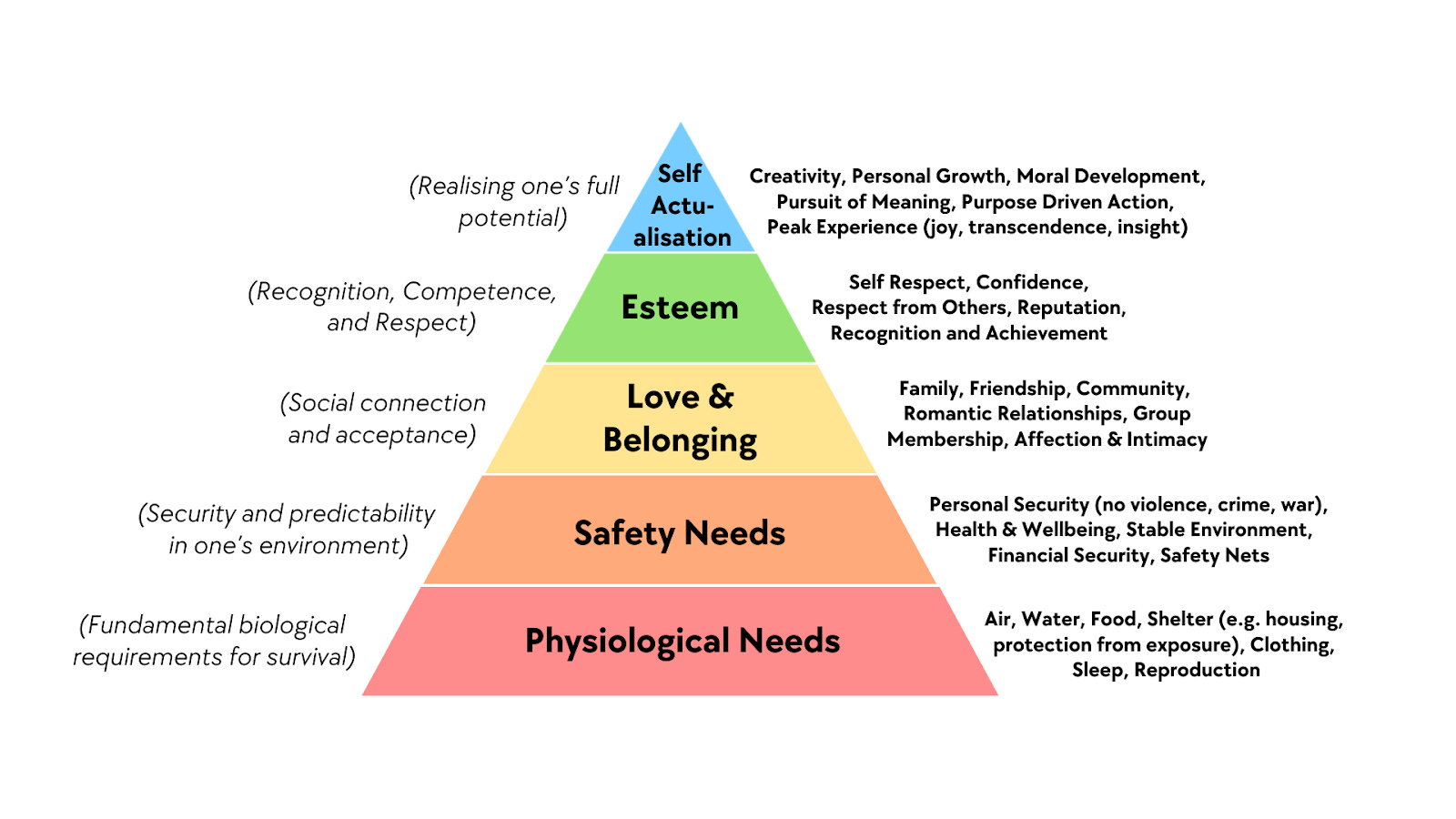
.png#Licensing)
High-control groups and cultic systems know this. And they weaponize it.
Researcher Janja Lalich identified key characteristics of cultic systems, and what’s striking is how each one specifically targets and inverts our fundamental human needs:
Safety becomes conditional. Instead of providing a safe and secure base to live, the group creates an environment where questioning equals punishment. Your physical, spiritual, and emotional safety depends on compliance. Members are often encouraged to live and socialize only with other group members, isolating you from outside support systems that might notice the harm.
Belonging requires conformity. The group preaches an “us versus them” mentality, creating artificial in-groups and out-groups. You belong - but only as long as you believe correctly, behave correctly, perform correctly. The moment you express doubt, you risk everything. Members are often expected to cut ties with family and friends who might represent competing loyalties.
Esteem is controlled by leadership. Instead of helping you develop healthy self-worth, the leadership induces shame and guilt to control behavior. You’re simultaneously told you’re special (part of an elite group on a divine mission) and worthless (needing to be broken, reformed, or purified). The group dictates in minute detail how you should think, act, and feel - what clothes to wear, who to marry, whether to have children, how to discipline them.
Autonomy is eliminated. The group claims exalted status for its leader(s), who is accountable to no one. Mind-altering practices like excessive meditation, chanting, or debilitating work routines suppress critical thinking. Members must get permission for major life decisions. Personal goals and activities you had before joining are radically altered or abandoned entirely.
The ends justify any means. The supposedly exalted mission becomes justification for behaviors you would have found unethical before - lying to loved ones, collecting money under false pretenses, participating in abuse while calling it discipline or spiritual formation.
The result? People trapped in systems that promise to meet their needs but actually exploit those very needs for control. True believers feel there can be no life outside the group context. They are made to fear for their safety (spiritual, emotional, and even physical in many cases) if they leave or even consider leaving.
I had been lied to my entire life about what healthy spirituality looked like. I was being actively abused, and watching others be actively abused, and was told this was God at work.
This is why people return to abusive systems. This is why leaving feels like death. Your entire hierarchy of needs has been hijacked and redirected toward serving the system rather than supporting your flourishing.
And this pattern isn’t limited to organizations we comfortably label as “cults.” These dynamics show up in churches, mosques, synagogues, temples, political movements, and even online communities. Anywhere humans gather, these patterns can take root if we’re not vigilant about protecting genuine human needs over institutional control.
The question to ask yourself with any community you join is: Does your community help you meet your fundamental human needs, or does it exploit those needs to control you?
A healthy spiritual foundation doesn’t just change your relationship with faith - it changes your relationship with the entire world.
What a Healthy Foundation Actually Looks Like
So what does healthy actually look like? What would it be like to be in a world where everyone gets to thrive? Where everyone is seen as fully and equally human? Where everyone has their needs met?
Protection from abuse means structures that allow questioning. It means transparent leadership where power isn’t concentrated in the hands of one charismatic leader, or a select group of people, who can’t be challenged. It means accountability mechanisms that actually function - not performative committees that exist to protect the institution. In healthy communities, asking hard questions isn’t seen as a threat to faith but as an expression of it.
Healthy relationships look radically different from what many of us were taught. Marriages built on mutuality, where both partners are fully human and neither person’s needs are consistently sacrificed for the other. Parenting that’s authoritative rather than authoritarian - providing structure and guidance while respecting children as full human beings with their own thoughts, feelings, and autonomy. Clergy who model humility instead of demanding unquestioning obedience, who say “I don’t know” when they don’t know, who acknowledge their own need for growth and learning.
Personal autonomy in faith means you get to develop your own conscience, your own discernment, your own relationship with the divine (however you understand it). It means having the right to disagree - even publicly - without being shunned or punished. It means your questions aren’t treated as evidence of weak faith but as sacred acts of seeking truth.
These principles show up everywhere healthy spirituality exists. In Judaism, there’s a long tradition of arguing with the text, of wrestling with God (it’s literally what “Israel” means).
Buddhist practice emphasizes the need to better understand ourselves, to grow spiritually, and to detach from external pressures. The Baha’i faith explicitly rejects clergy having authority over individual conscience.
“The historical misuse of religious authority serves as a backdrop to this approach. Bahá’u’lláh recognized the dangers that arise when spiritual power is concentrated in the hands of a select few. Throughout history, clergy have often become gatekeepers, interpreting sacred texts in ways that best serve their interests or consolidate their influence. By removing the clergy entirely, the Bahá’í Faith seeks to eliminate the potential for such abuses. This ensures that the focus remains on the teachings themselves and not on the personal authority of any individual.”
- Why the Bahá’í Faith has No Clergy and How Spiritual Authority Works
What is healthy within one faith tradition will be healthy in all faith traditions. Because we all come with the same innate needs to be safe and healthy, as Maslow illustrated in his hierarchy of needs.
When a clergy member, church, or tradition tries to tell us that their specific organization differs from the rest of the world in what is needed to be healthy and safe, we have to call it out for the lie that it is.
The Ripple Effect: Beyond Religious Spaces
Here’s what I’ve noticed: people who’ve done the work of building healthy spiritual foundations show up differently everywhere - including in our politics and their behaviour online.
They’re less likely to engage in the all-or-nothing thinking that dominates so much of social media. They can hold nuance. They can disagree with someone without needing to destroy them. They can acknowledge complexity without it feeling like a threat to their entire worldview.
Here’s what’s fascinating to me: the same dynamics that create unhealthy religious spaces show up in secular spaces too. Cancel culture operates on the same black-and-white thinking as fundamentalism. There’s an in-group and an out-group. There’s a purity test. There’s punishment for questioning the orthodoxy. The vocabulary changes, but the power dynamics? Remarkably similar.
Political polarization thrives on these same unhealthy foundations. When you’ve been trained that questioning equals betrayal, that the world is divided into the righteous and the wicked, that nuance is weakness - you bring that framework into every space you enter. You can’t suddenly turn it off when the topic shifts from theology to politics.
But when you’ve done the work of building a healthy foundation? When you’ve learned that you can hold your convictions while still respecting others’ full humanity? When you’ve practiced staying in relationship with people you disagree with? That changes everything. It changes how you navigate difficult conversations. It changes how you engage with people whose politics differ from yours. It changes how you respond when someone challenges your perspective.
A healthy spiritual foundation doesn’t just change your relationship with faith - it changes your relationship with the entire world.
”By their fruit you will recognize them. Do people pick grapes from thornbushes, or figs from thistles?Likewise, every good tree bears good fruit, but a bad tree bears bad fruit.A good tree cannot bear bad fruit, and a bad tree cannot bear good fruit.Every tree that does not bear good fruit is cut down and thrown into the fire.Thus, by their fruit you will recognize them.”
- Matthew 7:16-20
An Invitation
I don’t have all this figured out. I’m not standing at the top of the mountain beckoning you to climb up to where I am. I’m somewhere on the path, still learning, still discovering what healthy actually looks like in practice.
But I’m committed to asking better questions. And I’m inviting you to ask them with me.
This year, I’ll be exploring what healthy foundations look like across different aspects of life and faith. We’ll dive deeper into specific topics - healthy leadership structures, what mutuality really means in relationships, how to navigate deconstruction without losing yourself, how to build spiritual practices that actually nourish rather than deplete.
Not because I have all the answers, but because I’m learning alongside you. I’ll be sharing insights from different spiritual paths, naming patterns - both beautiful and harmful - that show up regardless of the tradition’s label, and pointing toward what flourishing actually looks like.
Because we might not all be Christians, Muslims, Jews, Baha’i, Hindu, Buddhist, or even atheists - but we are all human. And we all deserve a community that honors our full humanity.
So here’s my question for you: What would healthy spirituality look like for you? What needs to be present? What needs to be absent? What would it feel like to thrive, not just survive?
Drop your thoughts in the comments. Let’s figure this out together.
“A deep sense of love and belonging is an irreducible need of all people. We are biologically, cognitively, physically, and spiritually wired to love, to be loved, and to belong. When those needs are not met, we don’t function as we were meant to. We break. We fall apart. We numb. We ache. We hurt others. We get sick.”
- Brene Brown, The Gifts Of Imperfection
In my deconstruction/reconstruction, I learned from the Eastern religions, the mystics, and the quantum physicists that everyone is related, and everything is connected. That's all I know and all I need to know. It changed my politics, my spirituality, even my personality. Today, I have an eclectic nonreligious spirituality. I cry more. I laugh more. I have more friends and deeper friendships.
I have a Zen practice, and I participate in several communities whose spirituality is similar to mine— NOT doctrinal, NOT evangelical, NOT exclusive. They acknowledge mystery, paradox, and uncertainty. Often, they see gods as symbols, not entities. I attend Quaker meetings. I'm in a Unity book club. I lead a deconstruction discussion at a UU church. I participate in a weekly Zoom call with Progressive Christians. I chant to Shiva at an ashram where my wife is on the board.
Moreover, I find connection in art, music, nature, and writing, as well as in community and service. After he died, Abraham Maslow's last book was released posthumously. He wrote that there is a step beyond self-actualization, namely, transcendence. Once we establish a healthy sense of self, we can recognize our interconnectedness and transcend our sense of self. Maslow believed that transcenders are typically more holistic, more intimate, more loving, and more natural.